Hawk H102 is a dual-channel transmit/receive SDR platform based on the ADRV9002 and Zynq XC7Z030. Use Gigabit Ethernet for IIO control and IQ transfers, or the FT601 USB3.0 data path. Applications can use the IIO GUI, GNU Radio Companion or C++/Python interfaces. Recommended software and verification
This guide covers Hawk H102 Rev.B / LogicRF Kuiper 1.2.1. With the factory-prepared SD card, connect and power on directly. With your own card, download and write the image first. Check Downloads and compatible versions for matching host software and device services.
¶ First use: follow this route
Start the illustrated quick start by choosing your SD card:
- Factory-prepared card: confirm it is installed → connect and power on → find the IP → receive. No image download or card writing is required.
- Your own card: download and verify the image → write and fully read back on the PC → safely eject → insert with H102 powered off, then follow the same power-on and reception steps.
The deployment and IIO GUI instructions use a Linux PC. A Windows PC is used for ADRV9002 profile generation, including ADI downloads, environment setup and templates. Selecting an existing rate/bandwidth combination does not require Windows.
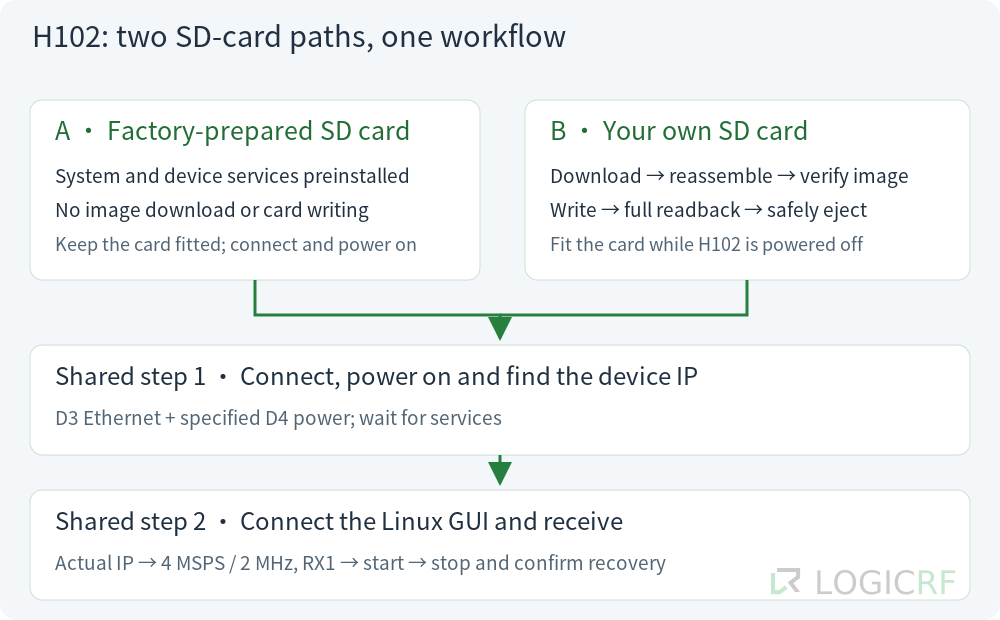
First-use and custom-profile workflow illustration
¶ Start here
| Task | Read |
|---|---|
| Prepare the board, supply and boot card | Hardware and wiring, SD card requirements |
| Use the factory-prepared card | Connect, power on and receive |
| Prepare your own card | Download and write, New-device deployment |
| Use the GUI or GNU Radio | IP-only connection, GNU Radio examples |
| Choose sample rate, bandwidth or channels | RF and sampling configuration |
| Receive, transmit or record IQ | Data transfers |
| Develop an application | IIO development, Attribute reference, C++/Python examples |
| Work with timestamps | Data protocol, GNSS and timestamps |
| Generate profiles or modify the system | Profile generation, System development |
| Diagnose or update | Troubleshooting, Release notes |
¶ Product and hardware
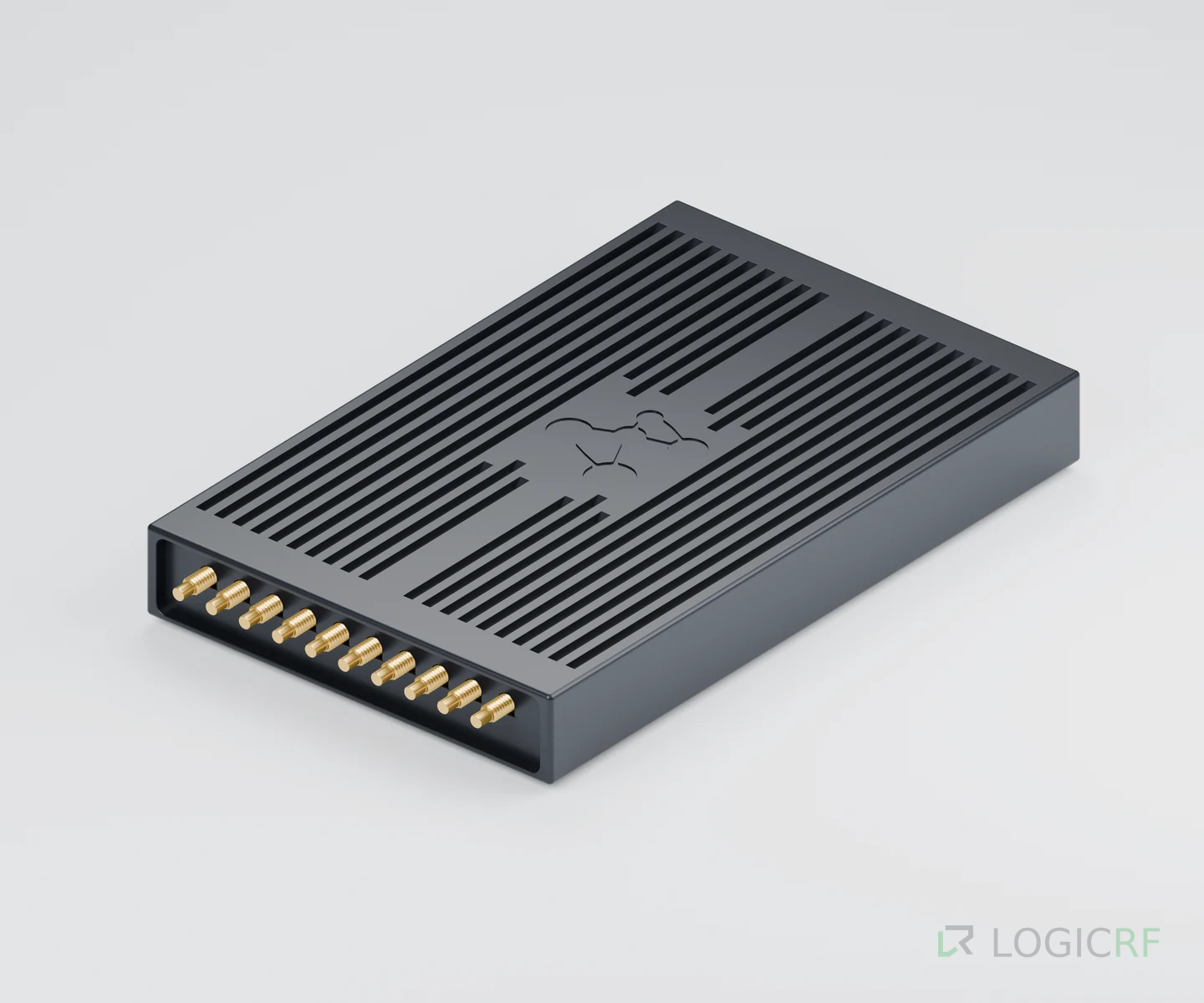
The standard H102 delivery includes its mechanical assembly. This is a 3D rendering; antennas and cables depend on the ordered kit.
| Item | Product information |
|---|---|
| RF and processor | ADRV9002 dual-channel transceiver and Zynq-7000 XC7Z030 SoC |
| Host interfaces | Gigabit Ethernet for IIO control/IQ; FT601 USB3.0 for raw FPGA data. Throughput and software support differ between paths |
| RF ports | TX1/TX2, RX1A/RX1B and RX2A/RX2B. Current profiles use RX1A/RX2A; check the hardware chapter before connecting |
| Time and synchronization | GNSS, reference clock and PPS; see the GNSS chapter for validity, UTC association and accuracy limits |
| Storage and boot | MicroSD boot; see deployment and system chapters for image writing, expansion and new boards |
| Expansion | Board-level RF-control FPC and high-speed expansion interfaces. Connector presence does not imply complete software support |
| Software | LogicRF-customized Kuiper, IIO GUI, native GNU Radio Companion examples and C++/Python APIs |
¶ Product interfaces
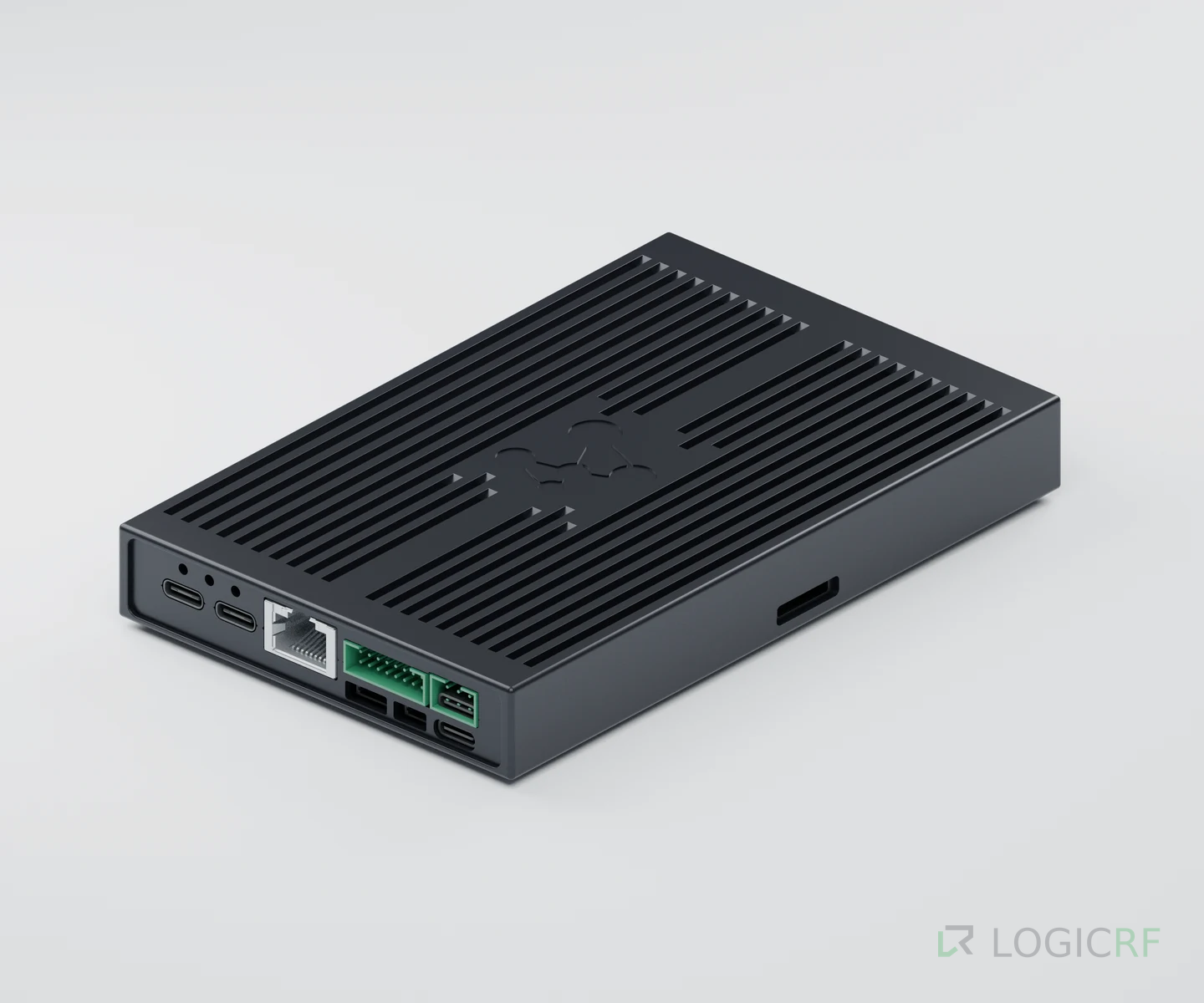
See hardware reference for connections and interface definitions.
¶ Architecture
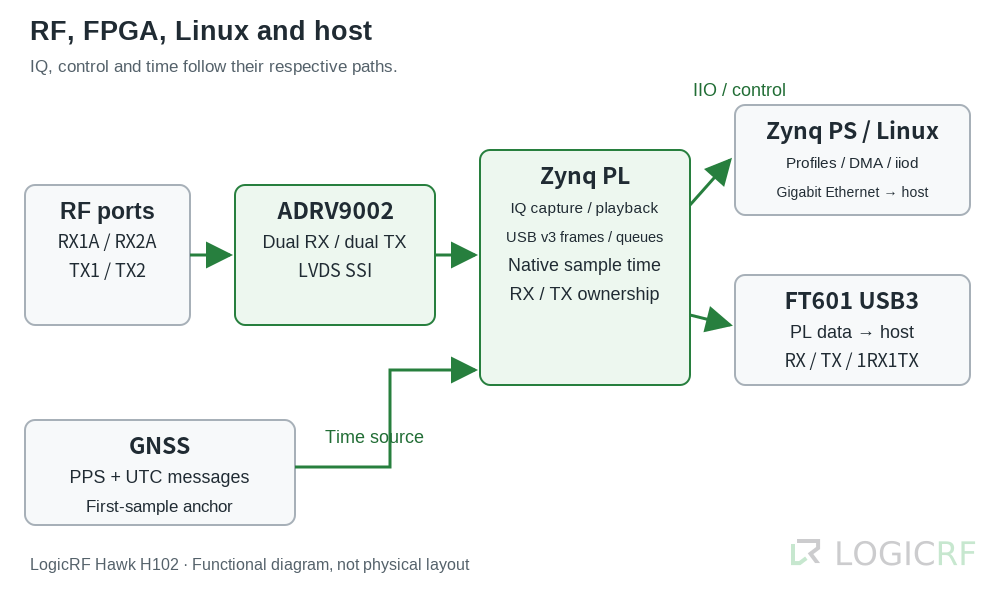
Functional relationships only; the diagram does not show physical connector positions or dimensions.
| Layer | Components | Role |
|---|---|---|
| RF | ADRV9002, RX1/RX2 and TX1/TX2 | Conversion, filtering, gain and digital interface |
| FPGA | XC7Z030-FFG676-2, ADI SSI and LogicRF RTL | IQ capture/playback, USB framing, queues, native counts and time association |
| Linux | Zynq PS, SDK1 kernel, iiod and profile services | IIO control/buffers, 29 profile transactions, boot and recovery |
| USB data | FT601, USB3.0 SuperSpeed | Data path between external host and PL |
| Network data | Gigabit Ethernet, libiio/iiod | Control and IQ; throughput depends on network and processing capacity |
| Time | GNSS PPS/UBX and native sample domain | UTC association for the first RX-frame sample, validity and time epoch |
¶ Parameters and versions
| Item | Version1.2.1 |
|---|---|
| Default sample rate / RF bandwidth | 40 MSPS / 20 MHz per channel |
| Built-in profiles | 29 combinations × independent/shared LO = 58 packages; 0.192–61.44 MSPS. See the profile table |
| Profile baseline | Dual RX / dual TX, FDD, RX1A/RX2A, 300 MHz device reference, dual-lane LVDS DDR, 16-bit I/Q |
| ADRV9002 stack | SDK 1.0.0 / API 68.21.6 / Firmware 1.0.2 / Stream 0.7.22.0 |
| Kernel | 6.6.0-h102-sdk1-candidate-calfix1-regbounds1-sharedlo1; the build identifier remains in its name. The image manifest and tags identify the release |
| Build tools | Vivado 2024.1 and PetaLinux 2024.1 |
| User space | Downstream customization of ADI Kuiper 2025-03-18 Full, Bullseye / Kuiper 11.2 |
| USB protocol | H102 v3, 128-byte header, default 2048 IQ16 samples per frame |
| Power / boot | 12 V input, SD boot and first-boot expansion |
The IIO GUI supports RX and sweep tuning settings from 30MHz to 6GHz. GUI TX and GNU Radio tuning settings span 50MHz to 5.8GHz. Choose sample-rate/RF-bandwidth pairs from the configuration table.
¶ Software components
| Component | Purpose |
|---|---|
| LogicRF Hawk H102 Kuiper | SD boot system, kernel, RTL and built-in RF profiles |
| Device services | Host control using the device IP; after installation, normal use requires no Linux username/password |
| IIO GUI | Profiles, tuning, receive/transmit, spectrum and IQ operations |
| gr-logicrf | GNU Radio device module and native editable GRC flowgraphs |
| Profile-generation tools | Generate profile, stream and initialization files matching the device stack |
System images and host applications update separately. Check the compatibility table rather than inferring compatibility from one component's version.
¶ Operating scope
Available network throughput depends on sample rate, channel count, format and host. Budget IQ16 payload as sample rate × channels × 4 bytes. High-rate multi-channel applications need a suitable data path and actual integrity checks.
Spectrum amplitude is relative. GNSS digital time association does not establish antenna-port delay or calibrated absolute RF performance. Establish application-specific calibration for power, noise, response or absolute time measurements. See individual chapters and Release notes for software support and limits.
¶ Product specifications and hardware manuals
See product specifications, hardware reference and mechanical integration. Chinese and English PDFs are listed in downloads and matching versions. PDF document revisions and software versions are independent; use the current download table for the matching system and host applications.