Current system: Kuiper 1.2.1 uses device API 0.1.0-ip36-panel1, capability 3 and IIO profile ABI 1. See current source/RTL/metadata mapping and verified basic queries.
For LogicRF Hawk H102 Kuiper 1.2.1. This chapter is for application developers and covers device interfaces, profile transactions, C++/Python examples and operating requirements. For routine GUI/GNU Radio operation, see IP-only access.
All devices, channels and attributes · Examples and instructions · Development downloads
¶ Terms used in this chapter
| Term | Meaning |
|---|---|
| Managed session / owner | A control process with exclusive access to one device, responsible for start, stop, deadlines and recovery |
| permit | Permission granted by that process after checking device, profile and session identities before a data operation |
| main / post | Session execution / independent cleanup; cleanup confirms stop and restores the device |
| stream_id | Identity of one data stream; restarting after stop uses a new identity |
| time_epoch | Generation of a valid time-association interval; updated when association is re-established, never manually reset |
¶ 1. Versions and interface layers
| Layer | Baseline | Purpose |
|---|---|---|
| H102 image | 1.2.1, tag h102-kuiper-1.2.1-image, commit 57d5baaf88c70d70922bc4c818accf8f343fbc1c |
Boot, board drivers and installed tools |
| Linux kernel | 6.6.0-h102-sdk1-candidate-calfix1-regbounds1-sharedlo1 |
candidate remains in the build string; the released image manifest establishes identity |
| Image metadata SHA256 | 7b58e2f3eb0d8427d35af6378e91f7c138e9386b2f0acf981830ebf79aeafd42 |
/etc/h102/sdk1-image.json |
| ADRV9002 SDK / API / FW / stream | 1.0.0 / 68.21.6 / 1.0.2 / 0.7.22.0 | RF stack, versioned separately from host libiio |
| Host libiio examples | 0.23 baseline; reject 1.x, accept 0.x versions at least 0.23 | C/C++ ABI and Python ctypes |
| H102 profile ABI | h102-profile-control/abi_version = 1 |
Asynchronous profile selection |
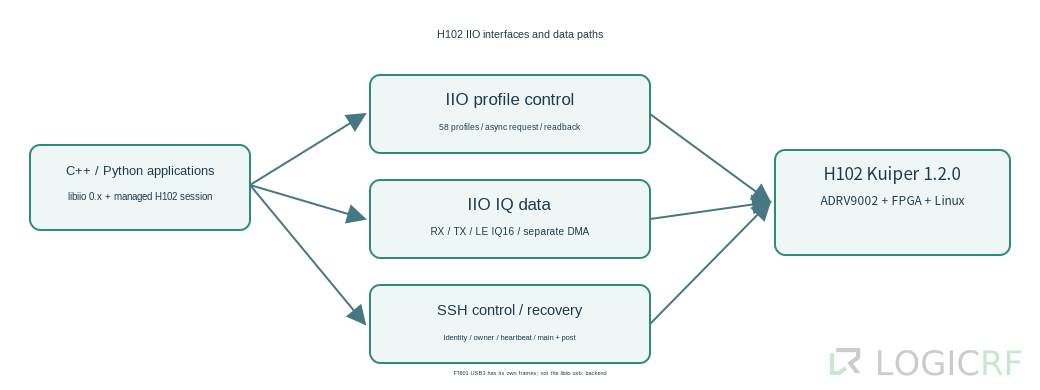
Normal applications use libiio context → device → channel → attribute / buffer. Profile selection uses ordinary IIO device attributes. Normal current GUI/GRC access is IP-only.
The RF SDK API is separate from host libiio. See the pinned ADI libiio 0.23 reference for generic function signatures.
The complete inventory here means the image's exposed devices, channels, ordinary attributes, buffer attributes and debug entries. Maintenance entries are identified separately. Exposed debug, hopping and TDD attributes do not imply that built-in FDD profiles support those operating modes.
¶ Install and compile
Use a Linux host with C++17, CMake, libiio runtime/development headers and Python 3.10+. Ubuntu packages include build-essential cmake libiio-dev; check the actual library is 0.x. These examples do not use libiio 1.x stream/block APIs.
Linux PC · Run in the tool or project directory named here; set paths to the actual installation and files.
python3 -m venv .venv
.venv/bin/python -m pip install -r examples/iio/requirements.txt
source .venv/bin/activate
cmake -S examples/iio/cpp -B build/h102-iio
cmake --build build/h102-iio -j 8
build/h102-iio/h102_iio --help
Queries need libiio and the Python standard library. See C++/Python examples for complete steps.
¶ 2. Connection, identity and topology
Output or format reference · Compare with actual data. No command or substitution.
C++ / Python application
 ├─ Ethernet → libiio / iiod → PHY attributes + 4 independent DMA devices
 ├─ Ethernet → h102-profile-control → configuration broker → approved packages

FT601 USB3 data transport uses its own framing and SDK; it is not libiio usb:.
| Role | Unique device name | Channels |
|---|---|---|
| Profile control | h102-profile-control |
No sample channels |
| RF control | adrv9002-phy |
Input voltage0/1 = RX1/2; output voltage0/1 = TX1/2 |
| RX1 | axi-adrv9002-rx-lpc |
Input voltage0_i / voltage0_q |
| RX2 | axi-adrv9002-rx2-lpc |
Input voltage0_i / voltage0_q |
| TX1 | axi-adrv9002-tx-lpc |
Output voltage0 / voltage1 = I/Q |
| TX2 | axi-adrv9002-tx2-lpc |
Output voltage0 / voltage1 = I/Q |
| RX/TX LO | adrv9002-phy |
Output altvoltage0/1/2/3 = RX1/RX2/TX1/TX2 LO entries |
| Clock/monitoring | ad9528-1, xadc |
Health and sensor readback; see the reference |
| Maintenance | Two axi-core-tdd, 43c50000.axi_reg, 43c90000.axi_trig, software trigger |
Distinguish by label/ID; not normal FDD start/stop controls |
iio:deviceN numbers can change with boot/module order. Discover unique device names. PHY input/output can share voltage0 IDs; pass the correct direction. Both TX DDS devices may have labels containing TX1: the parent device establishes physical ownership.
Built-in profiles use RX1A/RX2A. Physical A/B selection belongs to the generated configuration; SSI I/Q channel names do not switch physical RF ports.
¶ Query examples
Linux PC · Use the connected device’s actual IP or URI and your local installation paths.
python3 examples/iio/python/h102_api.py --uri ip:DEVICE_IP xml
python3 examples/iio/python/h102_api.py --uri ip:DEVICE_IP status
build/h102-iio/h102_iio ip:DEVICE_IP profiles
build/h102-iio/h102_iio ip:DEVICE_IP read adrv9002-phy frequency altvoltage0 out
Ethernet IIO queries require only the device IP and do not provide encrypted authentication. Device maintenance is separate from ordinary application access; use the matching GUI/GRC managed sessions for actual data operations.
¶ 3. Profile-control API
¶ All ten attributes
| Attribute | Access | Meaning |
|---|---|---|
abi_version |
R | Integer, currently 1 |
available |
R | Space-separated exact IDs; 58 packages = 29 rate/bandwidth combinations × 2 LO modes |
select |
R/W | Exact ID; a write queues a request, not completed application |
active |
R | Verified current ID; may return ENODATA while busy/unavailable |
previous |
R | Previous managed ID |
status |
R | State machine below |
error |
R | Latest transaction error or unknown-outcome information after recovery |
configuration_id |
R | uint32 configuration transaction ID within the boot |
request_id |
R | uint64 sequence within the module instance, restarted after reload |
active_info |
R | Independently verified JSON cache |
Output or format reference · Compare with actual data. No command or substitution.
ready/applied/rolled_back/rejected
          │ write select
          ▼
        queued → applying → applied
                         ├→ rolled_back
                         └→ rejected
backend unavailable / heartbeat expired → unavailable
Stop capture/transmission before profile selection, which reinitializes the chip. Save request/configuration IDs before a write; afterwards match this request's ID, terminal state, active profile, actual parameters and boot.
Serialize writes across clients. If request IDs show contention, report an unknown outcome rather than accepting another client's success. After backend reconnection, ready establishes reverified current configuration only. An error containing BACKEND_RECONNECTED_REQUEST_OUTCOME_UNKNOWN means the interrupted request's terminal result remains unknown. Do not automatically repeat select after a timeout; query actual state first.
Linux PC · Use the connected device’s actual IP or URI and your local installation paths.
# Explicit profile change; stop other RX/TX clients first
python3 examples/iio/python/h102_api.py --uri ip:DEVICE_IP select 8msps-4mhz
build/h102-iio/h102_iio ip:DEVICE_IP select 8msps-4mhz-common
¶ active_info fields
| Field | Meaning |
|---|---|
schema |
JSON structure version |
active / configuration_id / boot_id |
Profile, transaction and boot identity; bind together |
parameters.rx[] / .tx[] |
Per-channel channel, sample_rate_hz and rf_bandwidth_hz |
clock |
Manifest clock parameters, not GNSS/RTL counter readback |
ssi |
Declared sample-interface settings |
api |
ADRV9002 API, currently 68.21.6 |
sha256 |
Managed profile/stream input hashes, not a complete chip export |
provenance |
Generator/configuration source |
verified_monotonic_ns |
Board monotonic verification time, not UTC |
qualification |
Package applicability marker; also verify the current device, image and profile identities |
The profile JSON does not provide live RF carrier values. Read PHY LO attributes. See Profile generation for generation, version matching and import.
¶ 4. RF parameters and shared LO
| Parameter | IIO location | Unit/type | Rule |
|---|---|---|---|
| RX center | PHY output altvoltage0/1.frequency |
Integer Hz | Tune actual LO groups, then read each affected channel |
| TX center | PHY output altvoltage2/3.frequency |
Integer Hz | Independent TX LO or the same target as shared RX |
| Shared-LO atomic capability | PHY fdd_shared_lo_atomic |
Read-only boolean, 1 = supported | Capability flag, not a frequency command |
| RX gain | PHY input voltage0/1.hardwaregain |
dB text | Check gain_control_mode; AGC is not fixed manual gain |
| RX gain mode | Same channel gain_control_mode / _available |
Enumeration | Read profile-supported values; save old mode before changes |
| TX attenuation | PHY output voltage0/1.hardwaregain |
Negative dB | Positive attenuation A maps to -A; check range and step against the active configuration and application |
| Actual Fs/BW | Four PHY channels sampling_frequency / rf_bandwidth |
Integer Hz | Switch profile groups and read back all four channels |
| RF state | PHY channel ensm_mode / en |
Enum/boolean | Managed by the session; raw examples do not enable it automatically |
| Calibration | PHY initial_calibrations / _available |
Enum/command | Preserve device policy; explicit run is maintenance and can take a long time |
| NCO | PHY RX/TX nco_frequency |
Signed Hz | Digital offset, not the LO carrier; verify against bandwidth |
The RX driver tuning guard is 30–6000 MHz; the matching GUI RX/sweep setting range is also 30–6000 MHz, while GNU Radio uses 50–5800 MHz. An accepted range and carrier readback do not establish calibrated frequency, amplitude or full-band performance. RX gain limits depend on the matching SDK/profile table. Do not reuse TX limits for RX or invent one gain range for every profile.
Select independent or -common mode explicitly. Shared mode places all four ports on LO2. With capability=1, one frequency write updates enabled ports sharing that LO; it does not promise atomic arbitrary-attribute updates or complete failure rollback. Online shared-LO tuning during TX is unsupported. The tune workflow uses native transactions and independent post-checks, retaining the verified new frequency.
¶ C++ / Python attribute-write form
These fragments show standard IIO calls. First own the device's managed control session, save prior values and provide recovery. Do not write while another application captures/transmits. Use the matching GUI/GRC tuning workflow for a runnable entry.
Development host · Use the library or recording specified here. Match the device address, channel and input file to your setup.
// phy is adrv9002-phy in the context, not a sample DMA device.
auto* rx = iio_device_find_channel(phy, "voltage0", false);
char previous[128];
ssize_t n = iio_channel_attr_read(rx, "hardwaregain", previous, sizeof(previous));
if (n < 0) throw std::runtime_error("read gain failed");
// After checking MGC and the profile gain table, gain_db is validated decimal text.
ssize_t written = iio_channel_attr_write(rx, "hardwaregain", gain_db.c_str());
if (written < 0) throw std::runtime_error("write gain failed");
// Read back and verify; session finally/post restores previous gain and gain_control_mode on failure.
Development host · Use the library or recording specified here. Match the device address, channel and input file to your setup.
# Use this chapter's Context; write gain only inside an existing managed transaction.
phy = ctx.device('adrv9002-phy')
rx = ctx.lib.iio_device_find_channel(phy, b'voltage0', False)
write = ctx.lib.iio_channel_attr_write
write.argtypes = [C.c_void_p, C.c_char_p, C.c_char_p]
write.restype = C.c_ssize_t
ctx.check(write(rx, b'hardwaregain', gain_db.encode()), 'write gain')
actual = ctx.read('adrv9002-phy', 'hardwaregain', 'voltage0', False)
# Compare actual; on failure restore saved values and confirm recovery.
Set gain_db using the actual profile gain table; no universal default is supplied. For reception and recording, use the matching GUI/GRC workflows linked below.
¶ IQ data and runtime checks
Follow the IIO lifecycle: create context, discover devices, enumerate and enable channels, create buffers, RX refill / TX push, then release buffers and context. Check return codes, timeouts, actual scan format, sample stride and channel order at every step. Stop data sessions before profile changes; after an error, confirm actual device state before recovery.
The matching IIO GUI and GNU Radio provide reception, recording and transmission workflows. Ethernet IQ16 admission is 64 MB/s, calculated as sample rate × channels × 4. A successful query or displayed spectrum does not establish recording integrity. See API and protocols and GNSS for USB framing and time association.