GNSS associates RX data with UTC. The reference point is the FPGA acceptance cycle for native IQ, not host packet arrival or a calibrated RF-connector input instant.
¶ Check time status after connecting an antenna
- Connect a matching GNSS antenna to the GPS-marked port and position it where satellite signals can be received.
- Check the serial baseline below, then open a receive example using the GNU Radio installation and operation guide. Select the installed USB backend, device IP, channels and matching profile. Connect the FT601 data port to the computer running the application.
- Start reception and read the time-quality text for each channel.
Valid device digital time; UTC accuracy uncalibratedmeans the received USB frames contain valid device digital time.Invalid timemeans that time information cannot be used for UTC association.Relative sample timeis relative sample timing, not GNSS UTC. - To retain a result, use a recording example and inspect
recording.jsonafter normal completion. Expectstatus=PASS_RECORDING,backend=usbandtime_quality=device_digital_valid_utc_uncalibrated. Keep each channel's.h1miindex containing frame time and sample indices; see recording and replay for the file format.
Linux PC · Run in the tool or project directory named here; set paths to the actual installation and files.
# PC: replace this path with the completed recording directory; reads results only.
python3 -m json.tool /path/to/recording/recording.json
Time status comes from received frames. A serial-baseline check, network-IIO reception or host-clock adjustment does not produce the same USB hardware-time status. If time acquisition fails, retain the application error/result and follow troubleshooting. Do not edit the epoch or open another GNSS serial reader.
¶ Time formation
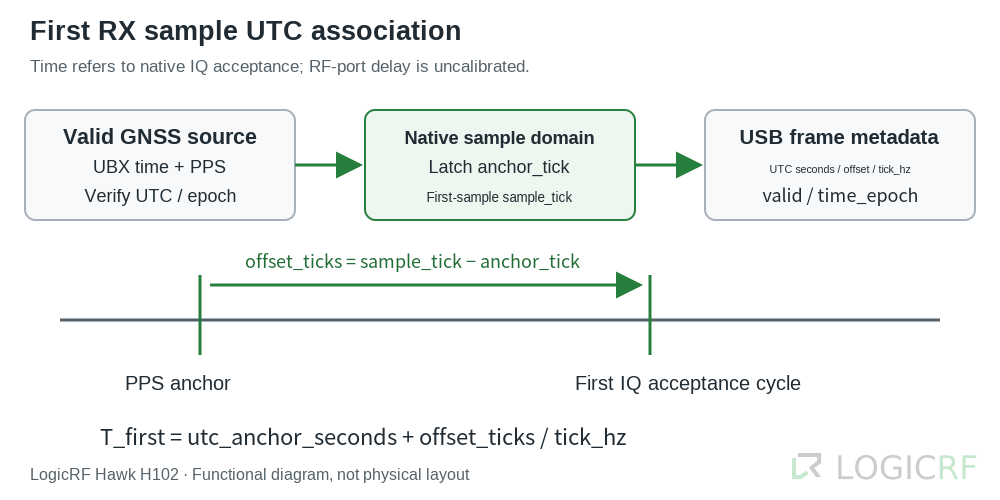
- GNSS supplies time messages and PPS; source checks establish UTC/epoch validity.
- Each channel's native domain records sample counts at IQ acceptance and their relation to the PPS anchor.
- The FPGA latches IQ blocks, configuration and first-sample metadata together and transfers them into USB frames.
- The host checks valid, epoch, source and tick frequency before reconstructing time with integer rational arithmetic.
An antenna connection or PPS alone does not prove valid UTC. A shared source for RX1/RX2 does not establish MCS, phase calibration or RF-delay calibration.
¶ Fields and formulas
| Field | Meaning |
|---|---|
timestamp_valid |
0 invalid; 1 means this frame has interpretable time |
utc_anchor_seconds |
Integer UTC POSIX seconds, epoch 1970 |
sample_offset_ticks |
Nonnegative tick difference from anchor to first sample |
tick_hz |
Sample-counter clock for this configuration; not always 80 MHz |
time_epoch |
Generation of a valid time interval, updated on reconfirmation/recovery |
time_source=1 |
GNSS PPS/UBX |
timestamp_reference=1 |
FPGA native IQ acceptance cycle |
time_scale=1 |
UTC |
time_quality=1 |
GNSS UTC/PPS associated; RF delay not calibrated |
Output or format reference · Compare with actual data. No command or substitution.
T_first = utc_anchor_seconds + sample_offset_ticks / tick_hz
Fs = sample_rate_num / sample_rate_den
ΔT = Δsample_index / Fs (within the same continuous channel/stream/time epoch)
At 40 MSPS, tick_hz is 80,000,000 and offset=400 means 5 microseconds. At 20 MSPS, tick_hz is 40,000,000 and offset=400 means 10 microseconds. This illustrates units, not absolute timing accuracy.
Development host · Use the library or recording specified here. Match the device address, channel and input file to your setup.
from fractions import Fraction

def first_sample_utc(header):
    if not header["timestamp_valid"] or header["tick_hz"] == 0:
        return None
    return Fraction(header["utc_anchor_seconds"], 1) + Fraction(
        header["sample_offset_ticks"], header["tick_hz"]
    )
Keep integer/rational values until final display; converting to float early loses fractional precision. The USB domain interprets latched first-sample metadata and does not replace it with current Linux time.
¶ Invalid time, loss of lock and recovery
| State | Interpretation |
|---|---|
| Invalid time | time_epoch, UTC seconds, offset, tick_hz and source/reference/scale/quality are all zero; no fabricated UTC |
| Valid time | Nonzero epoch, matching source/units, tick_hz matching the actual configuration |
| PPS/UTC failure | Revoke validity and mark the affected interval; do not extrapolate trusted UTC |
| Reconfirmation | Use a new time epoch; do not join absolute-time curves across epochs directly |
| STOP tail | List incomplete frames separately; do not invent the final frame's first-sample time |
Offset may be nonnegative up to tick_hz+tick_hz/1000, so it need not be less than one second. This is the existing PPS-period tolerance, not permission to extrapolate after loss of lock. The system manages the persistent epoch file; never delete it or set it to zero manually.
¶ Antenna and interface matching
The GNSS antenna port carries DC bias. Use an antenna and cable matching the delivered GNSS configuration. Before connecting an instrument or external RF source, check its DC tolerance and DC-blocking requirements. Do not use this antenna port as a general-purpose DC power output.
¶ Check the GNSS baseline (H102)
H102 shell · Run after SSH or serial login. Use the interface and configuration names on this unit.
systemctl show h102-gnss-uart-baseline.service \
  --property=ActiveState,SubState,Result
sudo cat /run/h102-gnss-uart-baseline.json
sudo stty -F /dev/ttyPS1 -a
Expect ActiveState=active, SubState=exited and Result=success; the JSON contains baud=38400 and echo=false. This confirms serial configuration only, not valid GNSS UTC. UART0 is the login console; UART1 is the GNSS path. Do not open a second UART1 reader and compete for messages.
¶ Auxiliary records to retain
| Record | Association keys | Content |
|---|---|---|
| Configuration | device_id, stream_id, configuration_id | profile/stream SHA, actual Fs/LO/BW/gain, API/FW, first effective sample |
| Time diagnostics | device_id, stream_id, time_epoch, channel, first_sample_index | Original UTC week/tow, PPS sequence, sample_tick/anchor_tick, period and source state |
| IQ frames | Channel/stream/sequence | Complete header and IQ; do not order solely by host arrival |
Persist configuration records before RUN. Associate time with actual native anchors; a snapshot sample_tick is not automatically a frame's first-sample tick.
¶ Timing limits
UTC POSIX cannot uniquely represent an inserted leap second. This version does not provide guarantees for leap-second transitions, extended holdover, absolute RF-port delay or nanosecond physical accuracy. Treat uncertain UTC as invalid and use a new time epoch after association is re-established. Ordinary network-IIO buffers do not carry the USB 128-byte time header; applications requiring these fields use the matching USB data and metadata path.