Osprey T808 is an RFSoC software-defined radio platform for multichannel reception, spectrum analysis and programmable signal processing. It provides eight receive channels, board management, and local host and high-speed network connections. Transmit expansion requires the companion daughtercard.
New product. This page describes hardware resources and integration options. Available functions depend on the delivered software, firmware and assembly options. Sustained throughput, inter-board coherence, RF performance and environmental ratings depend on qualification of the specific delivered version.
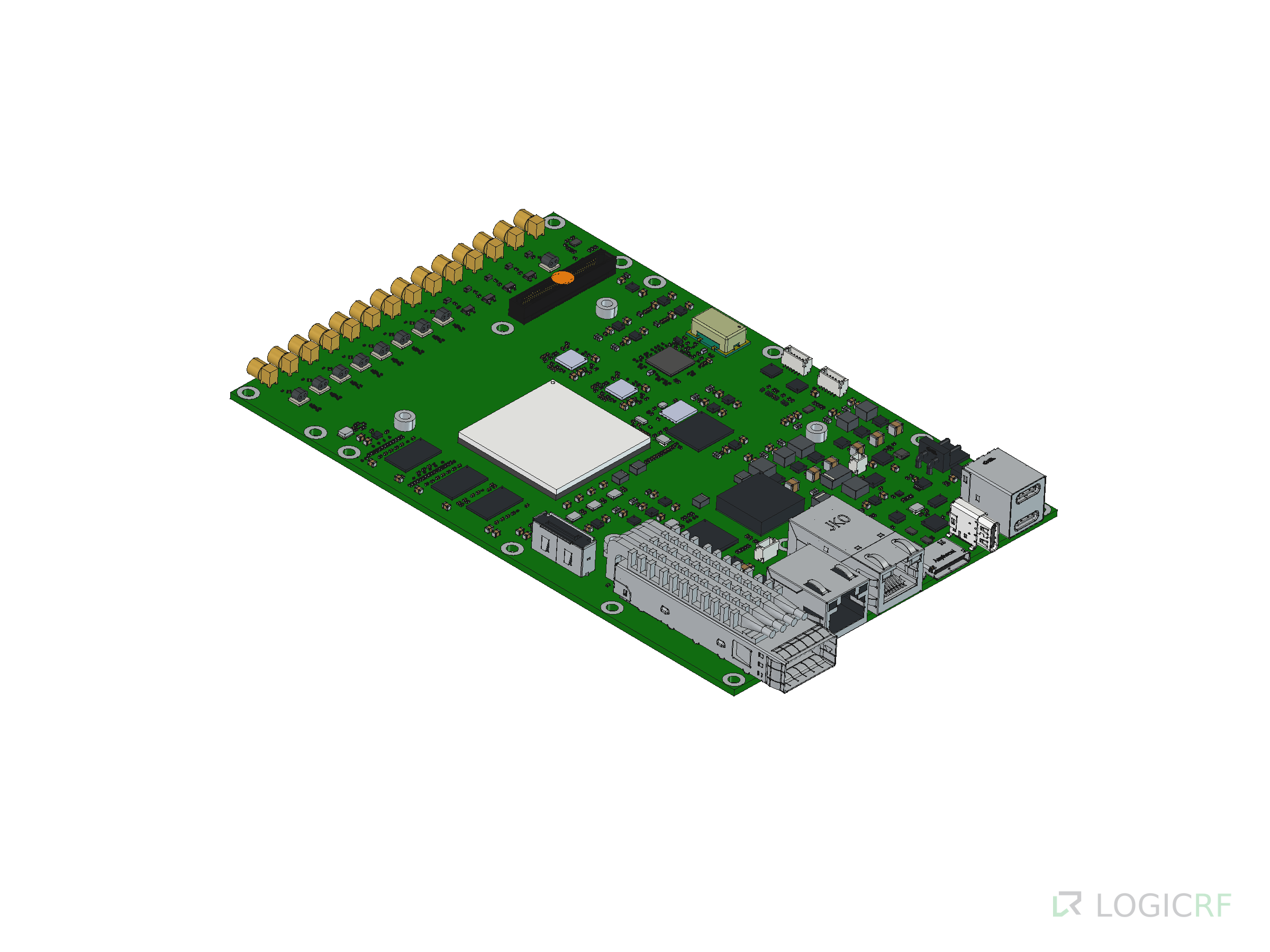
¶ Resources and interfaces
| Item | Configuration notes |
|---|---|
| Processing platform | AMD Zynq UltraScale+ RFSoC XCZU47DR, quad-core Arm Cortex-A53 and programmable logic |
| Receive resources | Eight 14-bit RF-ADCs and eight SMP inputs; nominal 50 Ω, AC coupled |
| Converter sampling capability | RF-ADC device maximum of 5 GS/s per channel; operating configuration and analog passband are separate |
| Transmit expansion | Eight 14-bit RF-DAC resources through an expansion card; device maximum of 9.85 GS/s |
| Memory | 4 GiB PS DDR4 and 2 GiB PL DDR4 |
| System storage | 32 GB onboard SD NAND and a spare SD-card interface |
| High-speed links | OCuLink with a PCIe 4.0 ×4 Endpoint design; QSFP28 for a 100GbE data path |
| Network and maintenance | Dual Gigabit RJ45, a USB 3.0 Type-C device interface, USB debug serial and an independent BMC |
| Reference and events | 10 MHz reference, GNSS, PPS, IRIG-B DCLS, TRIG and SYNC |
| Power and size | Nominal 24 V DC; 60 W board design budget, active cooling; 180 ×120 mm board outline |
Converter limits are not guaranteed module analog bandwidth or sustained output rates. The expansion card defines DAC matching, filtering and analog-output characteristics. Dimensions exclude connector overhang, cooling and expansion cards.
¶ System architecture
The PL handles sample processing, digital downconversion and user algorithms. The PS handles configuration and application services. An independent BMC handles power control, status and voltage monitoring. Management traffic, sample data and precise synchronization events use separate interfaces.
OCuLink targets a local host Endpoint connection; QSFP28 targets high-speed network transport. Host PCIe topology, DMA, memory and storage must match the actual output rate. An interface rating does not establish end-to-end throughput.
¶ Multiple modules
A four-module arrangement targets 32 channels and can use T808-SYNC for shared-reference and event distribution. A common 10 MHz reference, PPS, converter alignment and channel calibration address different requirements. Sharing a frequency reference alone does not establish inter-board coherence.
Read interfaces and integration for RF, reference, event, network and power connections.
¶ Documentation and delivery
Provide the required channel count, RF range, IQ output rate, host link and synchronization requirements to support to confirm the hardware revision, software set and delivery documentation. LogicRF GitHub is the entry for code and teaching examples; specific repositories and permissions follow the delivery arrangement.